GLP-1 Vial Conversion Safety: Avoiding mg, mL, and Unit Errors
A practical safety guide for checking prescribed GLP-1 vial conversions and recognizing high-risk unit mismatches.
GLP-1 Vial Conversion Safety: what this page can answer
GLP-1 searches often combine a medicine name, a vial strength, and a request for syringe units. This is exactly where a tenfold error can occur. FDA has reported hospitalizations linked to compounded semaglutide dosing errors and confusion among milligrams, milliliters, and syringe units. A calculator must therefore act as a verification aid, not a prescriber.
This glp 1 calculator guide concentrates on why syringe markings cannot be copied from another vial or discussion post. That boundary is deliberate. A calculator can divide, multiply, and convert units, but it cannot establish that a vial contains what its label claims, choose a medically appropriate amount, confirm sterility, or replace instructions from a licensed clinician or dispensing pharmacist. The safest use of the page is to audit arithmetic that has already been specified elsewhere.
The phrase “calculator” can hide several different questions. Concentration asks how much mass is present in each milliliter. Volume asks how much liquid contains an already verified mass. Syringe markings translate a liquid volume onto a particular barrel scale. GLP-1 Vial Conversion Safety searches often combine those questions, so this article separates them and identifies the input required for each one.
Read the GLP-1 Vial Conversion Safety label before calculating
Begin with product identity, not a desired result. Record the exact name, dosage form, total mass, stated concentration when present, final volume, lot information, storage language, and the organization that supplied the product. For GLP-1 conversion safety, a missing unit is not a minor formatting problem. It prevents the number from being interpreted safely.
Next, label every value as mass, volume, concentration, or device marking. Milligrams and micrograms are mass units; milliliters are a volume unit. A value expressed as mg/mL or mcg/mL is a concentration. Marks on a U-100 or U-40 syringe represent fractions of a milliliter and do not identify a universal amount of GLP-1 Vial Conversion Safety. Keeping those four categories separate prevents most tenfold and thousandfold mistakes.
A vial amount is also not a schedule or individual amount. If the GLP-1 Vial Conversion Safety container says 20 mg, it describes the total mass associated with that container. It does not tell a reader how frequently to use the product, which route is appropriate, or whether the product should be used at all. Those decisions sit outside this calculator and require product-specific professional guidance.
GLP-1 Vial Conversion Safety: Write beside every value where it came from: vial label, pharmacy label, official instructions, prescription, or clinician. If a value came from a forum, chart, seller comment, or another person's vial, do not use it as a calculator input.
A worked GLP-1 conversion safety example
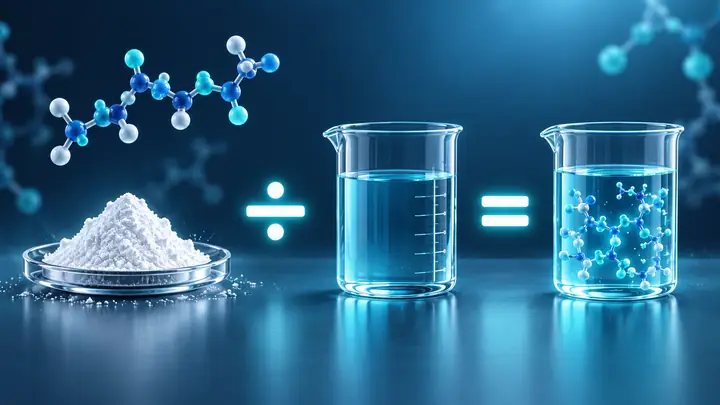
Consider a purely mathematical example using a hypothetical 20 mg vial and a verified final volume of 3 mL. Dividing 20 mg by 3 mL gives 6.667 mg/mL, which is 6667 mcg/mL. The example demonstrates concentration only. It does not recommend that volume, identify a compatible diluent, or say that a real GLP-1 Vial Conversion Safety product should be prepared this way.
GLP-1 Vial Conversion Safety: If a licensed professional or authorized label separately supplied a target mass, the target would first be converted into the same unit as the concentration. The target mass could then be divided by 6.667 mg/mL to obtain a volume. Only after that volume is established could it be translated to the verified syringe scale. Reversing this order-starting with a desired syringe line-creates an answer without a valid clinical input.
Precision should match the measuring device. A browser can display many decimals, while a syringe or measuring device has a finite graduation. For glp 1 calculator, a result that falls between readable marks is a prompt to contact the pharmacist or clinician, not permission to estimate. Changing the final volume or device to make the result look convenient also changes the calculation and may contradict the supplied instructions.
How the concentration reacts to volume
With mass held constant, doubling final volume halves concentration; halving final volume doubles concentration. That inverse relationship explains why a copied chart is unreliable. Another GLP-1 Vial Conversion Safety vial may share the same total mass yet have a different final volume. The two containers would then require different volume calculations even if a professionally supplied target happened to match.
Audit a glp 1 calculator result
GLP-1 Vial Conversion Safety: First perform a dimensional check. Mass divided by volume must produce mass per volume. Target mass divided by mass per volume must produce volume. Volume multiplied by markings per milliliter must produce markings. If the units do not cancel in that sequence, the setup is wrong even when the calculator displays a polished number.
Second, calculate the result independently. Repeat the equation by hand, use a second calculator, or ask a dispensing pharmacist to reproduce it from the same GLP-1 Vial Conversion Safety label. Agreement between two calculations reduces arithmetic risk, although it still does not verify product identity, quality, sterility, appropriateness, or the target amount.
GLP-1 Vial Conversion Safety: Third, test for a decimal shift. Compare the result with values ten times higher and ten times lower and inspect how the decimal was entered. Convert milligrams to micrograms explicitly by multiplying by 1,000. Write a leading zero for values smaller than one, such as 0.25, and avoid unnecessary trailing zeros that could be misread.
Fourth, compare every output with the physical device and the written instructions. A U-100 syringe has 100 marked units per milliliter, while a U-40 syringe has 40. The same liquid volume therefore maps to a different printed number on each scale. GLP-1 Vial Conversion Safety does not change that device relationship; concentration determines how much mass is contained in the volume.
Stop conditions specific to GLP-1 conversion safety
- The product identity or regulatory category is unclear.
- The label and written directions state different concentrations.
- The target came from a generic chart rather than a qualified source.
- The syringe scale is assumed instead of read from the device.
- The calculated volume is too small to measure clearly.
- The seller's page is the only source of safety or quality claims.
Evidence and product context for GLP-1 Vial Conversion Safety
Evidence must be matched to the actual product category. An FDA-approved medicine, a pharmacy-compounded preparation, a cosmetic product, and a research-only material are not interchangeable simply because a peptide name appears in each description. For GLP-1 conversion safety, review official labeling and regulator databases rather than using a seller's catalogue as the final authority.
Compounded drugs are not FDA approved and do not undergo the same premarket assessment as approved products. FDA has also reported serious dosing errors involving compounded injectable semaglutide, including confusion among milligrams, milliliters, and syringe units. That history is relevant to glp 1 calculator because it demonstrates how ordinary unit mistakes can become clinically significant.
Research-only labeling deserves equal care. “Research use only” is not a quality certification and does not establish suitability for human or veterinary administration. A certificate should be evaluated for lot matching, methods, laboratory identity, dates, specifications, and limitations. PeptideCalculatir does not independently test the GLP-1 Vial Conversion Safety products discussed in educational or affiliate content.
Commercial availability is not evidence of effectiveness. Affiliate buttons can help fund publishing, but they do not change the standard of proof. This page separates affiliate disclosures from its arithmetic and links readers to primary regulatory sources. Compare that approach with our related guide, Tesamorelin Calculator Guide: Concentration and Volume Math, which examines another conversion risk from a different angle.
GLP-1 Vial Conversion Safety calculator questions
Does this page choose an amount or protocol?
No. It explains GLP-1 conversion safety and processes numbers that a qualified source has already provided. It cannot account for medical history, diagnosis, contraindications, interactions, treatment goals, product authenticity, or local law.
Can I copy a final volume from another GLP-1 Vial Conversion Safety example?
GLP-1 Vial Conversion Safety: No. Worked numbers are demonstrations, not preparation instructions. Use only the product-specific diluent and volume supplied by the authorized manufacturer, pharmacy, or licensed professional.
Why can the same syringe marking represent different masses?
GLP-1 Vial Conversion Safety: A syringe marking represents volume. The mass inside that volume depends on concentration. When concentration changes, the mass represented by the same line changes too.
What if the calculator disagrees with the label?
Stop. Do not choose the result that looks more familiar. Ask the dispensing pharmacist or prescriber to reconcile the exact GLP-1 Vial Conversion Safety product, concentration, target, final volume, device scale, and arithmetic.
Where should regulatory claims be checked?
GLP-1 Vial Conversion Safety: Use FDA drug databases and safety communications in the United States or the corresponding national medicines regulator elsewhere. Check the date, product form, indication, and whether a statement concerns an approved, compounded, or investigational product.
Continue with a related calculation
Build on this guide with Research Peptides: Evidence, Approval Status, and Safer Product Research, compare the unit workflow in Tirzepatide Reconstitution Calculator: A Unit-Conversion Guide, and review another safety angle in CJC-1295 + Ipamorelin Calculator: Blend Math Explained.
Primary sources used for this guide
FDA: dosing errors with compounded injectable semaglutideFDA: concerns with unapproved GLP-1 drugsFDA: risks of compounded drugsFDA: bulk substances that may present safety risksGLP-1 Vial Conversion Safety: Written by the PeptideCalculatir Editorial Team for unit-conversion education. No clinician review is claimed. The page does not provide a protocol, individualized dose, diagnosis, treatment recommendation, or endorsement of an unapproved product.
Related calculator articles
 Research Peptides: Evidence, Approval Status, and Safer Product Research
 Tirzepatide Reconstitution Calculator: A Unit-Conversion Guide
 CJC-1295 + Ipamorelin Calculator: Blend Math Explained
 GHK-Cu Calculator Guide: Form, Route, and Concentration Matter
 Peptide Concentration Calculator Formula: mg/mL and mcg/mL